Showing posts with label policy. Show all posts

Thursday, November 21, 2013

The Racket at Yaba LCDA


Governor Fashola recently stated that  local government officials involved in "traffic management do not represent any local government. My personal experience begs to differ. 

point of arrest

Recently on my way back to Lagos Island from Yaba,I was stopped by a uniformed Yaba LCDA (Local Council Development Area). Uniform pictured below
 The officer said I had passed one way (pictures of the said one-way below) and that I would be cautioned. The  "caution" was that I would go back and pass the right route. I agreed and he entered my car. Once inside, he instructed me to drive to the LCDA office. 
(I was behind another car that was"arrested". Anyone plying this route would notice that cars driving North divert and face cars going South) like below. I was going South and yet was the traffic offender. 
I was in no mood to argue with the arresting officer.  A man pictured below approached me and asked where I was coming from, where I was going, where I lived and worked and I told him all except where I worked. He tried to make me offer him a bribe and I refused. I told him to let me know my fines and I would pay. He said I would do a psychiatric test, pay N25,000 fine, N500 gate pass and N2000 for tax clearance. When I heard the tax clearance, I asked why? I told him I don't have one, what if I am unemployed? I asked him to let me make some calls and after 5 minutes, he began to harass me for my keys and when I refused to hand it over, he told his officers to deflate my tyres. Then, I saw a man who looked like his boss, approached him  and told him what had  happened. He requested for the pictures they took of my offence ( which I was not allowed to see) and said it was one way. I mentioned the 2000 tax clearance fine and he asked who told me to pay that and I pointed to man pictured below. He requested for the booking sheet and changed my fine to N15500. I paid the fine. 

Trouble began when I requested for a receipt. Officer above issued the gate pass but was reluctant to issue a receipt. Booking officer (below) was also reluctant to issue a receipt.

After making a serious fuss and calling "the boss" that reduced my fine,a lady approached me, gave me N5000  and said the boss said it should be returned to me and I was given receipt below that did not state the full "offence"
I tried to reach the numbers of the LCDA chairman (Jide Jimoh on his number given on the LCDA's website)  and the Council Manager (Tunde Ojikutu) and the lines were switched off. Dear governor Fashola, miscreants are not running this racket. It is run by Local government staff and this is another example of the impunity that occurs in Lagos state. 


Sunday, August 25, 2013

On National Development


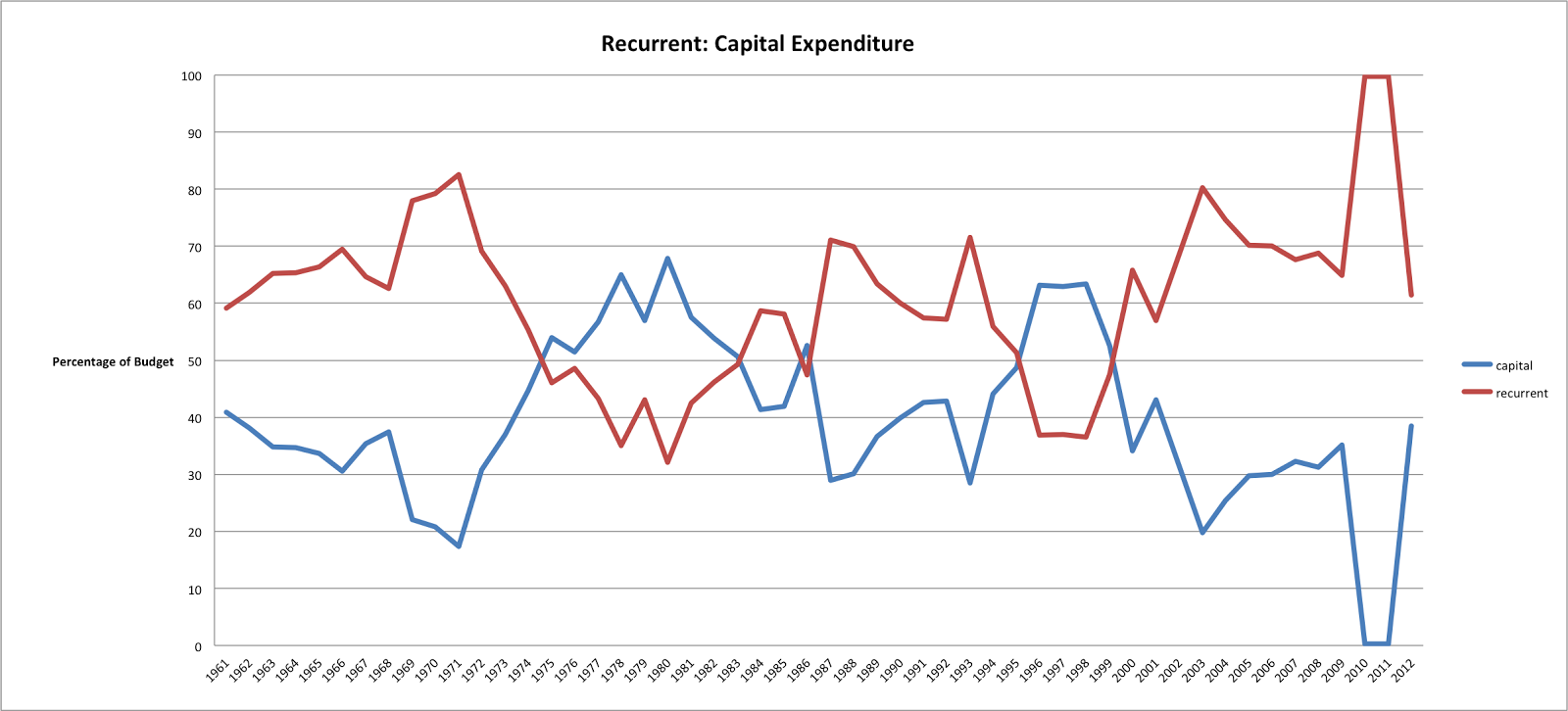
Expenditure of the Federal Government of Nigeria, 1961-2012.
Source: CBN Statistical Bulletin: Special Anniversary Edition& CBN Annual Reports 2009, 2010, 2011, 2012


I have pondered when our development issues as a country began to degenerate and our public expenditure has given me an answer. Previously, I had thought that the excessive spending on overhead and administrative public expenditure was a recent development but history proved me wrong. Since 1961, the chunk of our annual budget has gone into administrative costs (wages, salaries for elected and civil servants maintenance, contingencies and subventions) i.e recurrent expenditure. 

The only periods capital expenditure (defense,education, agricultural and social sectors e.g roads, housing, education infrastructure etc) exceeded over heads was between 1975-1983 and 1996-1999. Apart from the FESTAC 1977 quarters, I cannot remember any other tangible projects associated with those periods.

Chinua Achebe in his "There was a Country" noted an Igbo proverb that "A man who does not know where the rain began to beat him cannot say where he dried his body". In the light of the constant strikes in the health and education sectors, our government needs to identify where the rain of under development began to beat us so we can begin the process of drying our body or changing our clothes.
 Deuces

Wednesday, July 17, 2013

We are our Police Force


There is a police officer that controls traffic on a road I drive. With his police hat on, he looks like he is in his thirties. Sometime ago, as I drove by, he removed the hat and I realized that he could not be more than 23 or 24 years old and I wondered why such a young lad would join the police force.The Nigerian Police is the most reviled organization in Nigeria. Everyone loves to hate the Police. The reason for this hatred lies at the feet of the Police. Yet, it is not their fault.The Nigerian Police is a microcosm of our society. Their corruption, failings, befuddled thinking, ineptitude and lack of direction is a reflection of what we are as a people.The Police Force states her  objectives as:
-       Protecting the lives and property of fellow citizens and impartially enforce the law
-      Fighting crime both by preventing it and by aggressively pursuing violators of the law
-      Maintaining a higher standard of integrity than is generally expected of others because so much is expected of us
-      Valuing human life, respect the dignity of each individual and render our services with courtesy and civility
Of course the Police has not met any of these objectives because the foundation of the Nigerian Police is flawed. In the First Republic, when regional police forces existed, they were used for political intimidation of opponents by the government in power. When the Military took over and unified the police force, the art  and science of policing was not developed. In fact, it deteriorated.  I would say that the military deliberately under developed the Police. Basic systems such as a comprehensive Police database, kitting, training and development of Police officers was (and is lacking). Our Police Force lacks proper intelligence and investigation skills; if you commit a crime in Epe and move to Badagry, you rest assured that you would never be caught but if you are innocent and are in the wrong place you may become a government ward. I recall the case of  a lady that was condemned to death because she befriended a cultist. If proper investigation was done, this lady had no reason to spend 12 years in Kirikiri Maximum Prison.  You can also walk into a Police Station and get a Police report for anything for N3000 ($20). 
The ease of recruitment into the Force is incredible. I recall the distant relative who joined the Force because there was nothing else. The unfortunate thing is that this guy may become a Commissioner of Police tomorrow with no interest and skills in the profession and a dangerous tool in the hands of a childish Executive. 
The failings of the Nigerian Police Force are endless. Nevertheless, things cannot remain the same. We need to recognize that the Police Force that we have is what we made them. This recognition should spur us to do better-better in rebuilding the foundation for a good police force. When the report on the appalling state of the police barracks ran, the government responded by censuring the officers who spoke to the press.That censure was the wrong message. The government should have used that opportunity to effect changes starting from the Police Barracks.
To solve our Police Problem, the government should have an intervention fund for the police. This fund should be for proper renovation (and not just painting) of Police stations and Barracks. The sign that welcomes you to a Police Station is “Police is your friend”. I don’t feel that friendship when I walk into a Police Station.
Apart from physical renovation, our Police officers have to re-trained. It may be difficult to straighten a bent crayfish but nothing is impossible. Our officers have to learn that 2+2 is not 5, that cases are not black and white and that the person who gets their story in first is not always right. If you think that the police scenes in movies are made for movies, wait until you engage a police officer.
After physical, systems and mental changes are made,economic and status motivations have to be put in place so that our police force attracts the “better” that may be developed to become the best.
Our Police Force would never be perfect- that is a tall order. However, they would no longer be toys for soldiers, errand boys for politicians and powerful and they would no longer brutalize we civilians for 20 naira or arrest us indiscriminately.
It is time to build the Police Force that we want.

Answers anyone?
Have you noticed the propaganda ads for Mrs Allison Madueke when you visit Nigeria sites? Forms of Oceania’s Ministry of Truth are springing up here

Update:
The Punch Newspapers has this story on the state of Nigeria's Police Force as at December, 2013. Sigh. 

Sunday, March 03, 2013

The Drug Problem

Africa was and still remains an attractive trading route. Pre and post colonialism, African States have provided countries in Asia, Europe and America the route to move goods. Africa’s central location is both a blessing and a curse. It was a curse because it inspired slave trade and colonialism which set us back a few centuries.
In the last 60 plus years, this location has been a curse thanks to illegal drugs. Though the level of drug trade across the continent has not reached Afghanistan or Mexican heights, it is very worrying. Awareness of drugs and drug trade began in the 1980s. However, research show that it has been ongoing since the return of WW2 veterans and the discovery of coca (cocaine) farms in the 1950s. Until the 1980s, the trade went unhindered because European and American officials were unaware of Africa as a new route. Given the levels of unemployment and poverty in the continent, it is imaginable that Africans were lured into the trade for economic benefits.
The last two decades has seen the transformation of Africa has a hub for transportation and consumption of drugs (Cocaine, Cannabis, Marijuana and AMTs). From Guinea- Bissau, Kenya, Mali, Libya to Ghana and Nigeria, we have become exporters and consumers of Methamphetamines, Cannabis, Cocaine and heroin. Globally, the trade generates between 900 million dollars to three billion annually. The UN Drug Commission also reports that about about 35-50 metric tonnes of cocaine are trafficked annually (that is about 2200, 23kg travelling bags) and remember that this is what we know. Recently, 7 people were arrested for carrying large quantities of heroin in Kenya.                                  
Why is drug trade a problem?
Although, drug running is not the cause of Africa’s under development, drug trade makes our already weak and fragile institutions and systems weaker by threatening government authority and the rule of law- fairness, equity and justice. As a researcher observes “illicit drugs is not the main cause of destabilization instead it is a consequence of the pre-existing lack of stability”. Yet, It enables drug peddlers undermine the government. The money drug running provides allows peddlers to buy over the State and get away with anything. Government failure and inefficiency results in less development, more unemployment and more of the ills we currently battle. It shifts the focus from development issues to security issues. Just as corruption gives wealth to a few, the gains of drug trade also give wealth to a few people. Also, drug trade also affects our politics because it enables peddlers influence elections and buy over government officials.
Another reason why drug trade is a problem is terrorist financing; countries like Nigeria and Mali currently battle attacks from insurgent groups. The on going conflict in Mali is a case in point. It is believed that Al-Qaeda in Maghreb (AQIM), ANSAR DINE and AZWAD (the guerrilla groups in Mali) are funded with monies made from drug running. This is highly possible because Mali is known for cocaine trafficking. In 2009, a plane carrying drugs was burnt down after offloading at Tarkint in Northern Mali. The huge funds generated from drug smuggling provide a gigantic source of income for terrorist activities.
Drug running is also a public health issue and this is two-sided. First, there is an increasing number of users. In 2010, the estimated number of drug users is between 22-72 million up from about a million in the late 1990s and early 2000s. This portends health challenges for the continent. Imagine citizens yet to receive adequate treatment for Malaria now grappling with mental, HIV (research shows that drug use and HIV infections are related because of injecting drug use), and other drug related health issues. The second dimension is the discovery of coca and cannabis farms in the continent. Land that should provide food for nutrition is used for drugs.
On the other hand, it is argued that though drug trade is illegal, it is an income- generator as it has economic ripple effects. For instance, a drug peddler would employ people to build his new mansion, spend money at his local supermarket etc. thus creating prosperity for himself and others. A fair argument. However, this “economic benefit” is not lasting and drug peddlers have no reason to be benevolent.
To combat this problem, there is need for strong political will on the part of government. It is believed that African governments are complicit in drug running in their countries. We can recall allegations that some of our past military rulers were drug barons. Therefore, governments have to determine to tackle this problem head on without any sacred cows. In addition, there has to be tighter and stricter border controls. It was reported that over 1000 illegal routes into Nigeria was discovered. This is in addition to our already porous legal border routes. At airports, there has been thorough searching of travellers and drugs have been discovered. The same rigor should be applied to our borders.
Also governments should create public value for their citizens so that there is no incentive to engage in drug trade. That cliché says a stich in time saves nine and that is the case here. In these parts, we usually fail to connect the dots and treat issues as isolated cases. They are not. Drug running is a problem, a problem that causes other problems. It has to be addressed.

Wednesday, May 02, 2012

Dying for growth

First off: Title is credited to WB president.

I heard stories about how beautiful and serene Cotonou and Lome are. I was told the cities have regular light (yes they do) and how they can be vacation destinations. A recent road trip to Togo set me straight. I was shocked that the Cotonou and Lome that I heard about was far from the reality. That trip illustrated the need for meaningful development especially in the areas of infrastructure, education and the economy. On my seat I thought why is Africa declining? When would the continent catch up with others? When would Africa get beyond issues such as good roads, good hospitals, affordable decent housing and promote a solid economic base? 
 Africa’s infrastructural deficits has hindered the continent’s economic growth and effective participation in the global economy. The consequence of this is that the social, economic and political well being of a considerable number of her citizens is on the decline. One thing that is clear is that only Africa can develop Africa. World bank, IMF and other IFIs cannot are limited in their capacity to drive growth. Apart from the fact that development trajectories are not linear across continents (China, India, and South America’s development process is very different from that of the West – that Africa tries to so hard to replicate), Africa is about 2 centuries late in the industrialization process. Second the current WTO (World Trade Organization) regime benefits only the developed countries and negatively impacts the area Africa has comparative advantage- agriculture. 
Thus, it cannot be emphasized enough that African countries need to diversify their economies whilst transitioning from producers of primary goods to manufacturers and service providers. Development and economic growth are vital now because Africa is the fastest growing continent in terms of population. And as the Dettol advert goes “if Africa does not take care of her own who will? How can the continent jumpstart growth? 
The answer lies in quick wins as African countries begin to build systems and institutions that would ensure good governance and its attendant benefits. These strategies include: 
1) Encourage and integrate the informal economy: currently Africa’s informal economy (artisans, self- employed people, domestics, farmers, "engineers") generate 40% of Africa’s GDP. This means carpenters, mechanics, hairdressers, tailors generate large amounts of revenues the government does not get in taxes-that however is not the gist here.) The gist is that these groups of people because of the prohibitive nature of our systems cannot grow and develop their businesses. Thus, the pepper seller at Balogun continues to sell pepper for donkey years and never becomes a de-rica producer and Nigeria imports tinned tomatoes from Asia. The carpenter gets stuck in his cycle of subsistence and cannot become another Sokoa Chair center. Why because the barriers to creating a structured business in Nigeria is prohibitive- all those CAC requirements, cumbersome tax laws and processes, overhead costs. Who needs that when I can make a 50,000 piece of furniture and rest?. This results in a lack of creativity and innovation. As mentioned earlier the pepper seller cannot think of new ways of rejuvenating the business and spends the incomes she earns on getting by.
What should governments do? – formulate pro-poor policies that can give SMEs a proper foundation, ease the government regulations that make managing a business difficult. I would also suggest protectionist policies for businesses in agriculture. 
2) Invest in public health: as it is said, health is wealth. Citizens of a country can never be productive if they are not healthy. Governments have to heavily invest in health care systems especially preventive health. How many people do you personally know that have died needless deaths because drugs are not available? 
3) Invest in practical education so that the current skills gap that exists between what students learn and what the job market requires is closed. In addition, technical and vocational schools have to be properly utilized so that the artisan who tiles knows how to tile properly and not continue in the 20th century method of tiling. Similarly a look at Nigeria’s oil industry would show that expatriate are still very much involved in the production process because Nigerians lack the know how. 
4) Carve a niche: China’s is known for technology, India niche is IT. African countries have to look inwards and discover what can differentiate them and bring in money. Benin and Togo can actively develop their tourist destination like Ghana and Kenya. Benin can also utilize her location as a transport hub for West Africa to attract investments. Nigeria can take her pick from “computer village”- Nigerians may be cheaper than India and China-, brand our aba made products, re-build our textile industry, and tourism too. 
5) Effective use of regional bodies: regional bodies such as ECOWAS are under utilized. Regional bodies can be used to jointly build and develop infrastructure. Imagine a train that goes from Lagos to Accra and the intra trade that this railway would engender. In addition, countries like Togo and Benin can benefit greatly from the large size of Nigeria’s population if their informal economies are properly developed. Nigeria is a ready made market for them. Lastly Africa has a whole needs to take a stance on the WTO regime. What would the above lead to? If African countries get their acts together, build and maintain the required infrastructure and harness the potentials of the informal sector would that translate to Africa becoming a developed continent? Not yet, because there is a lot of catching up to do but at least, Africa would be on her way.

Monday, April 16, 2012

NASS, CPC and consumer rights


    Where I come from, there is this proverb translated as “It is God that chases flies for the tail-less cow”. It is safe to assume that in Nigeria, if you do not have connections,only God would fight for you. One can also make it a daily prayer that influential Nigerians should suffer the indignities regular Nigerians suffer so that these indignities are addressed. My beef on this issue relates to consumer rights and the helplessness of the tailless Nigerian. Three examples suffice. About three weeks ago, 125 Nigerians were deported from Oliver Thambo airport, South Africa for carrying “fraudulent yellow cards”. This issue escalated and was addressed by the government mainly because a Nigerian senator was among the deportees. It is common knowledge that South Africa is a xenophobic country and Nigerians are/have being/been mistreated in that country. However, the Nigerian government did not address the abuse of her citizens until a senator was involved. Second, the House of Representatives recently summoned Hyundai motors to explain why a faulty car was sold to a former representative. Is the National Assembly so caring that it now protects consumer rights? Third, I purchased a black berry phone with a one-year warranty from an authorized dealer. After two weeks of using the phone, it stopped working. I returned it to the manufacturer for repairs and/or replacement. After the run around the company gave me I resorted to using the police and an arrest to get a new phone.
   These examples illustrate the disorderly nature of our system where there are no structures and processes and where the use of might makes right. One would think that there are no consumer protection agencies in Nigeria with the way customers and clients are exploited and treated by organizations in Nigeria. However, it is interesting to note that there is a Consumer Protection Council in Nigeria. A function of this council is “providing speedy redress to consumers complaints through negotiation, mediation and conciliation”.
    On the paper this organization is the answer to the prayers of Nigerians but in reality, the organization is not as effective as it should/can be. Remember that I had issues with a phone dealer. I tried to contact CPC on their hotlines to no end. No one picked. If the defender is not available, how does one get redress? A second issue is that the organization has its hands in many pies. Some of the functions of CPC are also carried out by organizations such as Stanadard Organization of Nigeria (SON) and National Agency for Food and Drug Administration and Control (NAFDAC) resulting in duplication of functions. Third is that there are no contacts of responsible persons that an aggrieved customer can reach. On the website of the organization, you can send in a complaint. You receive a generic your-case-has-been-received-and –would- be- treated reply. However, there is no Chidi or Sola @cpc.gov.ng that I can reach if I do not get any response from the organization. The fourth issue with CPC is that of awareness. A considerable number of Nigerians do not even know the organization exists. The institution has to work on making itself known so can it can cater to its target audience- Nigerian consumers
    For CPC to function effectively, its role should be streamlined to consumer protection in the areas of exploitation, redress and advocacy.The organization can do this by:
- Ensuring that industries including government agencies have standards how clients and cases should be treated. Remember the stale pie you bought at an eatery and when you went back to complain you were told nothing can be done because you already paid for it or the meal you ordered did not look as advertised but you still had to pay for it. CPC can ensure that the food services industry bear the cost of their “off days”. 
- Promoting a retail  culture in the country: the organization can build trust among customers and businesses by building a retail culture  tilted initially in favour of the consumer. How many times have you bought something you want to return but cannot because “all goods bought cannot be returned or exchanged”?
-Visibility: the organization should create awareness not by jingles and adverts but by making public examples of offending businesses and organizations. I would be more likely to report an issue if I learn that MTN was penalized for authorized withdrawal of customer’s airtime or that Park n Shop was penalized for poor customer service.
   If CPC gets its acts together and is able to streamline its mandates and carry out these mandates effectively and efficiently, all Nigerians regardless of their social and economic connections and statuses would be protected from exploitation and one of the many  problems of Nigeria  would be checked off.

Wednesday, March 28, 2012

LET THERE BE LIGHT


As of today, Wednesday March 28, 2012, there has been no light where I live. The generator has been running since Saturday night (Well, the generator takes a three hour break and resumes for duty).  Erratic power supply is a pet peeve of mine. I cannot comprehend why there would be no constant power supply in Nigeria considering the resources we have and the amount of money that has been sunk into that industry. Our electricity challenges make me believe that our leaders do not care about addressing this issue.
I say this because, the process of electricity supply is simple.  It is divided into  three or  four stages. These are: generation(the process of converting raw energy into electrical energy), transmission (the transportation of electricity in high voltages from generation to distribution), distribution (process of delivering electricity at low voltages from the transmission network to the final consumer), and retailing ( this is purchasing wholesale electricity and selling it to the consumers). In Nigeria, we have stages 1-3 (handled by one company NEPA/PHCN). What are the traditional fuel sources of electricity? They are natural gas, hydro, and coal. This begs the question of why we cannot have constant power.
Anyways this post is semi- good news. Before I share the good news, some statistics:

  • Over 2 trillion naira was spent on “tackling” Nigeria’s power problem between 2000- 2007.
  •  In urban areas 40% of the population is connected to the national grid; in rural areas it is 15%.
  • We do not have electricity 60% of the time (that is what researchers say, my experience is more like 90%) About 60 million Nigerians own generators and as at 2009 N1.56 trillion was spent to fuel these generators.
  •  Nigeria claims to have an installed capacity of (6,000 Megawatts) but actually generate a peak of 4,000 Megawatts of electricity. This is a sixth of what New York generates (the State has a peak capacity of 37, 707 Megawatts. This is also a sixth of South Africa’s peak capacity.
Over the years, States (E.g. Rivers and Lagos) have agitated for the right to independently generate power. On the 7th of March, the NERC (Nigerian Electricity Regulation Commission) passed authorizations that would allow states and local government to generate and distribute their own power. You can read the regulations here and here.
 Ideally, these new regulations are good politically and economically: politically, residents in a state can hold their governments accountable for power supply. This is because state and local governments are closer to the people. From experience, I have witnessed residents visiting their representatives and leaders to report issues that affect them. Thus, citizens who feel strongly about power supply would make their demands known to the government. Related to this is that, it is easier to vote out a governor or local government chairman for failing to deliver constant power than a president.
 Economically, these regulations do two things. First, states that are not financially buoyant can collaborate with States that have the financial capacity to generate electricity. For instance South Western states of Nigeria can incorporate electricity generation and distribution into their DAWN (Development for Western Nigeria) Agenda, second, these regulations may provoke healthy competition among states and local governments and promote economic development. For instance, if Osun state has 24 hours power supply and my business is in Oyo State or Lagos, holding constant other factors, I would relocate my business to Osun and pay taxes there. This leads to more revenues for Osun State and Oyo may see the need for constant power supply. We see a real life example of this in significant number of Nigerian businesses and investments located in Ghana and South Africa.
 Practically, how can States utilize these regulations? I don’t think States that decide to generate their own power should create NEPA-like institutions because of the inefficiency of NEPA. If state governments get involved in generating, transmitting and distributing power, the same problems of NEPA would be recreated. I submit that States can provide the necessary infrastructure for generation and transmission. That is, States can enter into public- private partnerships (PPP) with interested investors. PPPs are necessary because States can’t go it alone for above reason and also because there are competing needs with limited resources. Alternatively, they can hands off PPPs and assist private investors get partial risk guarantees from IFIs like the World bank.
 Let us assume that the problem of capital is solved, how would the government prevent exploitation investors get capital to generate, transmit and distribute electricity, what would the government do to prevent exploitation. My answer is regulate and set prices (tariffs on electricity) like it is done in the US and UK. As an aside, in sister African countries like Ghana and Botswana, electricity generation is done by the state and there is constant power supply.
That said, I recommend privatization because of the Nigerian factor. However, in what ever PPPs that would come up as a result of these authorizations, the government should remember that their role is to protect the people from exploitation by businesses – hence the need for strong regulation- and yet create conditions that incentivize the private to come into this business.
 After all is said and done, what would be the role of the NEPA? One important issue that needs to be addressed is the issue of power generation and I propose that this should be the focus of the agency Our electricity generation is far below optimal and the FG’s goal is to generate 10,000 MWs by 2020. This is incredible! 10,000 MWs in 2011 does not effectively address our power problem now. I suggest that at the Federal level, the power ministry should work on harnessing and utilizing the sources of power generation. The ministry needs to look into other sources of power generation such as solar energy wind, coal and nuclear energy so that by 2020 we have an installed capacity of 50, 000 MWs.
 Ok, so that’s the end of my submissions and proposal.

 Deuces.