Friday, September 20, 2013

Change that changes nothing

My favorite History examination question was change in government is a change that changes nothing,discuss. 
At the time, Nigeria was 2 years into Obasanjo’s  civilian government and I think my teacher was already disillusioned by  the lack of the expected positive change Citizens anticipated in 1999.
This question has resonated  because it captures the essence of our governance issues in Africa. The difference between the  forms of governments we have is six and half a dozen 
In the century where  gov 2.0, collaborative government is gaining momentum and Countries have climbed higher in Maslow"Hierarchy of needs", Africa still grapples with failed leadership and its consequences (both physical and psychological) enabled by people who are afraid of change and willingly succumb to these leaders . It is like neighbours planting trees, whilst others have planted, watered and tended their trees, we are battling with planting ours.
I think we have a gene that accepts incompetent, authoritarian leadership. The oligarchic and/or hereditary nature of Africa’s leadership has impacted our development from Togo,Nigeria,  Zimbabwe and Egypt. The situation where certain people feel entitled to rule and access the common wealth without systems that allow other leaders to emerge has caused many conflicts across the continent. 
The events in Egypt could be the story of any African country. Egypt has been ruled by its military oligarchy since 1952.  All Egypt’s rulers (Nasser, Sadat and Mubarak)  and the current government emerged from the Military. For Egyptians, it has been the hand of Esau but the voice of Jacob.
The emergence of Mohammed Morsi was a welcome development to the extent that it brought a semblance of change. However, Morsi’s lack of political management skills and his fall into the absolute power corrupts absolutely trap led to his downfall. Egypt is back to square one with  political instability, deaths, high unemployment rates and disrespect for human and women rights.
The challenge of addressing our leadership  issues now is that it widens the existing development gap between Africa and  other continents. Africa is projected as the beautiful bride due to our increasing population (read as: potential market for services). For instance, UN reports state Nigeria  would be the new China in terms of population - 1 billion- in 87 years.Yet, rather than plan on how to leverage the powers that would accrue to us ( we get to have our say on issues, we become ( and already are) the go-to market for investors, the wealth-creation potentials if we (Africans) come up with services that meet our needs). Multinationals have seen the light and are investing here,  acquiring water rights,meanwhile,our leaders cannot provide electricity, good roads, healthcare, guarantee property rights, justice, fairness or ease the costs of starting new business.
We cannot afford to continue like this. We lost 400 years to slave trade and we are lagging behind in this phase of advancement. Creating the conditions that would bring about development and create value for citizens is not rocket science for any government. As Africans we need to get our values and politics right, then  we can sort out our economic problems. The government in power may not be able to give us the lifestyle we want but it can make life miserable for us through its actions and inactions. 
Let change count for something

Deuces. 
Monday, September 16, 2013

The Nigerian "system"


As mentioned in an earlier post, Nigerians distrust their government. In addition to the stated reasons, Nigerians distrust the government because it allows the “system” have its way with citizens. Two cases illustrate this.
In 2011, the Federal government of Nigeria changed the license plates for vehicles and rolled out a new drivers license scheme. The reason for the change is the new plates  and driver's license have biometric features (data and fingerprints) of owners making it easier to fight crimes and terrorism. I am still trying to understand that logic. However, the issue is not whether or not the policy is justified or necessary.  The issue is the costs in terms of money and time in obtaining these items. According to FRSC, the new plates cost 7500 naira to produce but are distributed to State Licensing Offices for sale at N10,000 (replacement) and N12,500 (new) for the regular plates numbers. In 2012,the Senate slashed the cost to N8,400. One year later, the story is different. I am not aware of anyone (including me) who has obtained the plates at the official rate. Prices have ranged from N15,000 to 25,000. As the September 2013 deadline draws near, the prices are sure to increase.
Obtaining the new Driver's license is also tedious. I know people who have been issued temporary cards since November 2012 and are yet to get their licenses. It took two colleagues three months to write the test and have their biometrics captured. Yet, the government expects all drivers to have new plates and licenses by the 1st of October, 2013 without putting in place internet connection and systems to capture biometrics and transfer to their central database. 
Getting a passport is another exhausting exercise thanks to the system. The official rate for a Nigerian Passport is N8,750. However,with N20,000 and prayers you can get your passport in 2 hours to 5 days (this may or may not include the facilitation fees you pay if you go with incomplete documents). Like the driver's license, there is no stated timeline for processing a passport.  
Our colleagues at the Customs also charge unreceipted duties as they please when you arrive at the airport with your luggage. They are quick to show you the act that says you must pay for new items valued above N50,000 (tip: if your luggage truly has personal not-for-sale items, keep your receipts and show the custom officials, bring out your phone and calculate exchange rates, be very firm and polite). The lack of transparency at government institutions promote this idea that a "system"is responsible for all our ills. The same immigration official that sits on your passport application because you refuse to play ball, complains about the deplorable state of our Country.
Yet, the system continues to survive because citizens allow it to. Why do we allow this rip-off?  To my mind, i think we bear it because we can afford to, it is convenient and it is the way the system works so we just go with the flow. No one takes on the system because the higher-ups are aware of what is going and just watch. Unfortunately, the one who does is either stingy or a trouble maker.
It is easy to throw our hands up in the air and surrender but for how long? The “system” we blame for everything wrong  comprises  friends, neighbours, relatives and church members. The extra cost of the number plate goes into someone’s pocket. Pushing back on  little things  it sends the message that we are truly tired of being cheated. Imagine if all the Nigerians went to the passport office with all the required documents and refused to bribe any immigration officer. The government on its part needs to create clear and precise service charters on the expectations of its agencies, consequences of not adhering to the charter and empowering  SERVICOM carry out its duties. Again, the government has to walk its talk.

Sunday, September 15, 2013

On Trust


It is known that Nigerians do not believe in their government. There is the we- against them mentality that even the government recognizes. As Dr Okonjo- Iweala said "I really agree on the issue of mistrust; I think it is part of the problems governments faced over the years. Nigerians have not seen their governments fulfilling promises". 
The ASUU strike is deadlocked because ASUU does not believe the Federal Government would keep its word. One of the causes of this strike is that the Federal Government has not kept to the 2009 negotiations.The growing mistrust of government begs the question why don't we believe in our government? We elected them. 
I have pondered on this and I think that we mistrust the government because:

  • The government has a proven track record of going back on its word. Government after government promised electricity, good roads, good education, health care,free and fair elections and failed to do as promised.Electricity  should have stabilized in 2000. It did not. Then, President Jonathan said it would by 2012. It has not. When I was in primary school, we used to sing "education for all by the year 2000".The magical year 2000 passed and recent UN statistics show that there are 10.5 million kids out of school.  
  • The government does not care about the people and its policies show so. The 2012 removal of fuel subsidy exemplifies this.The sources of the fuel subsidy leakage was known to the government. The president publicly said there was a cabal.It was clear that public funds were wasted through payments to marketers that failed to deliver fuel they were supposed to. Rather than penalize the government officials and marketers involved in this scam,the government punished Nigerians that rely on fuel for movement and electricity by removing the subsidy of fuel.The effects of this abrupt removal of the subsidy included; loss of lives,loss of productivity,rise in transport costs and food prices. When the price of fuel was reduced to N97, the change did not reflect in the cost of food items and services. Another example was the ban of motorcycles on major routes by Lagos State government. This ban is good policy on safety grounds but a caring government would make other sources of transportation available before implementing such a policy. Also,law enforcement officers would not indiscriminately destroy and burn motorcycles- siezure of motorcycles or hefty fines is deterrence enough for offenders. The effects of this ban is seen in long queues for inadequate BRT buses.
  •     There is no enforcement and lawlessness pays: Nigeria is one country where you can get away with anything if you have  the right connections but would be punished severely for the minutest of misdemeanors if you do not. To rub it in, you pay for your legitimate rights. There are no consequences for running the red light, tax evasion (except you are large organization and LIRS- [Lagos Inland Revenue Service] wakes up one morning to bill x4 of what you should have paid and then you complain that the government is fraudulent), cheating, theft of public and private funds. For instance, EFCC ( Economic and Financial Crimes Commission)  and and ICPC (Independent Corrupt Practices Commission) were set up to curtail corruption that is now entrenched in our society. Apart from the inconsequential cases that have been prosecuted, these organizations have been used as tools to punish erring political office holders. I can commit murder and go scot free. A sad example is the "ABSU rape" where the husband of the victim and the victim know the perpetrators and these people still live free in that community. Another incident that depicts the state of lawlessness in this country was  the case of a Personal Assistant whose driver stole $100,000 from him. When the driver was about to be arrested, he reminded his boss of his wrongs and the evidence available to him. The driver was released and the $100,000 was returned to the PA. Stories like these embolden people to do as they wish because there are no consequences. Thus, when the government claims it wants to fight corruption and lawlessness,  citizens take it with a pinch of salt.
  •    Nigerians mistrust the government because we mistrust ourselves.The people that make up the space called Nigeria have become untrustworthy-maybe that is why we find acts of honesty surprising-. The social capital of trust  in our country has been destroyed and the effects are seen in the way we relate with one another. We believe that everyone has an ulterior motive and that altruism no longer exists.Lack of trust causes us to inflate prices. For instance if a trader tells me an item costs N50, my Nigerian mind tells me the cost is N20 and the trader wants to rip me off. T Even the trader that wants to make an honest profit would price items at N40 because she knows that buyers would bring it down to N20. Also,the artisan who tells you he would come at 2 pm but shows up at 7pm builds in your mind the conception that artisans lack integrity.Our lack of faith in each other makes us disbelieve the government because the government comprises people like us!
The lack of trust in our country  feeds into the tribalism that has gained strength in recent times. The present government and successive governments need to build their credibility. The social cost of trust is becoming unbearable because as someone recently remarked, the Nigerian society appears to be one that everyone wants to grab what they can while they can at the expense of others. The result of this is a downward spiral that would do us no good. Whilst it would take deliberate efforts on the part of the people to trust each other,the government should lead the way by walking its talk. 

Deuces.

Sunday, August 25, 2013

Christian, know your God!

I think that Nigerians (and Africans) are deeply religious and serve God because of the things He does for us and not because of His ways. I believe that if this was not so, our attitudes ( corruption, lack of integrity, honesty, civility and cleanliness) would be reduced. Thus, I read with indifference then sadness the recent "fall of a man of God". This is not first neither would it be the last that would happen. Stories like this are to be expected because the Bible warns that "in the last days, there would be very difficult times. For people will love only themselves and their money....they would act religious, but they will reject the power that could make them godly [another version of the Bible says "having a form of godliness but lacking the power thereof]. Stay away from people like that. They are the kind who work their way into people's homes and the win the confidence of vulnerable women who are burdened with the guilt of sin and controlled by various desires (such women are forever following new teachings, but they are never able to understand the truth)- 2nd Timothy 3:1-7.
Therefore, the onus is on Christians to know Who they believe and Why they believe. Our Christian race is PERSONAL and we are to "fear God and keep His commandments"(Ecclesiastes 12:11). Yet we are not to ignore the fellowship of the brethren for reasons I would mention later. We should know who we believe so that:

  • We do not lose our faith over issues like this and offences perpetrated by the Church. The Bible again cautions us to "beware so that we are not carried away by the errors  of the lawless and lose our own secure footing" (2nd Peter 3:17)
  • We do not fall prey to the foolishness happening in the name of God. The Bible warns us "not to be carried about with every wind of doctrine, by the sleight of men and cunning craftiness, whereby they lie in wait to deceive (Ephesians 4:14).We see invitations to programmes like "automatic blessing, automatic answer", "Satan let me drive that car"or become oppression-conscious that every bad occurrence is the handiwork of people that do not want us to succeed. We are lazy Christians who unlike our Berean brethren do not "test everything we are told and hold on to what is good"( 1st Thessalonians 5:21)
  • We know God for his ways- that makes us better people and the salt of the earth- rather his awesome acts. If we know his ways, He would perfect us and  there would be no need to judge others or point out the speck in their eyes because the light in us would reveal their flaws to them  draw them to Christ
  • We do not give God's glory to men by worshipping them. To some people, their pastors can do no wrong and I wonder if their salvation is of God or of their pastor's. Pastors are humans who are to be honoured and prayed for because of the spiritual covering they provide for the church but are not meant to be worshipped. We are doing ourselves and men of God a disservice by hero- worship because God would not share His glory with any man. 
  • to"motivate one another to acts of love and good works... and encourage one another especially now that the day of his return is drawing near"(Hebrews 10:25)
  • because "from him the whole body (the church in all its various parts) joined and held together by every supporting ligament grows and builds itself up in love as each part (the individual) does its work.

As I mentioned earlier, as Christians we are to fellowship with other brethren that is, attend church
Fear God and keep His commands for this is the whole duty of man
deuces

On National Development


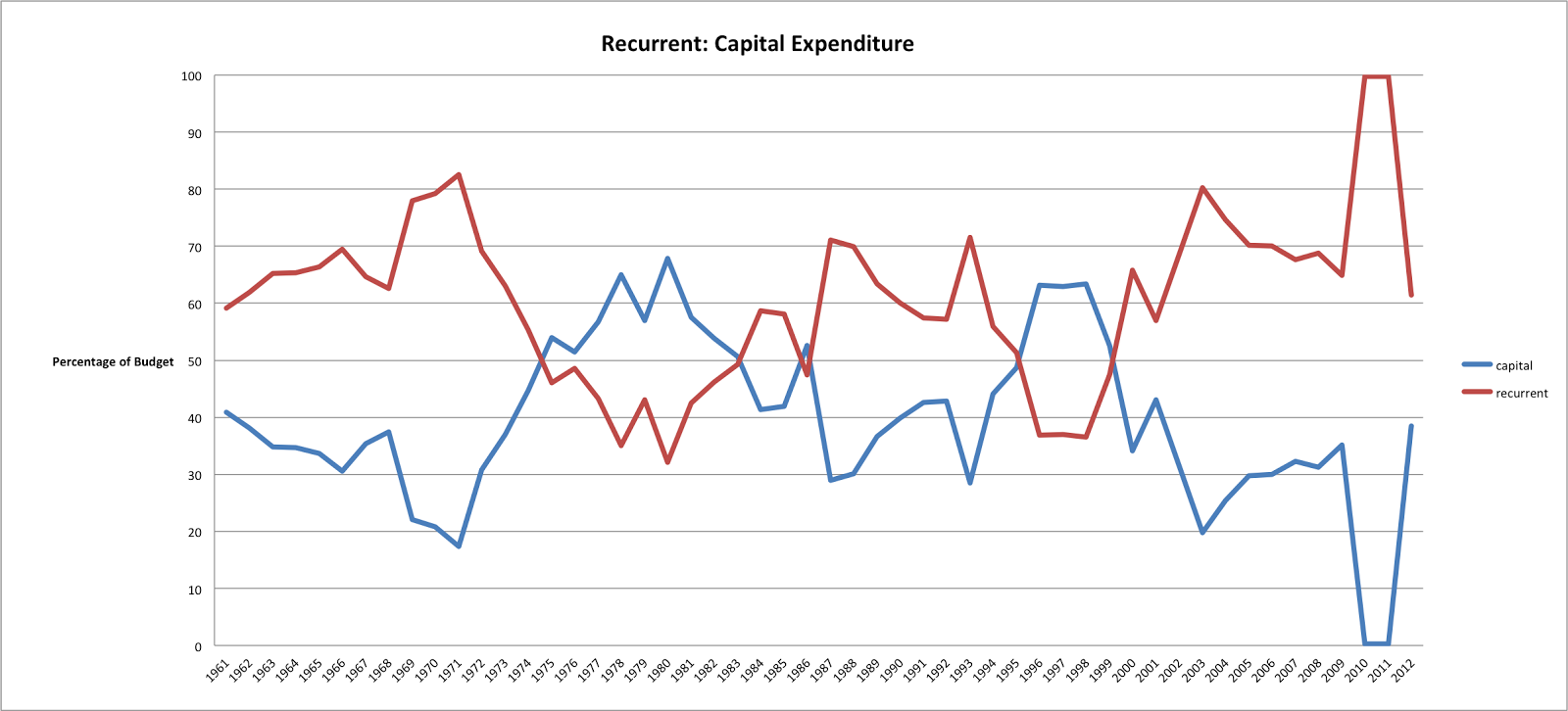
Expenditure of the Federal Government of Nigeria, 1961-2012.
Source: CBN Statistical Bulletin: Special Anniversary Edition& CBN Annual Reports 2009, 2010, 2011, 2012


I have pondered when our development issues as a country began to degenerate and our public expenditure has given me an answer. Previously, I had thought that the excessive spending on overhead and administrative public expenditure was a recent development but history proved me wrong. Since 1961, the chunk of our annual budget has gone into administrative costs (wages, salaries for elected and civil servants maintenance, contingencies and subventions) i.e recurrent expenditure. 

The only periods capital expenditure (defense,education, agricultural and social sectors e.g roads, housing, education infrastructure etc) exceeded over heads was between 1975-1983 and 1996-1999. Apart from the FESTAC 1977 quarters, I cannot remember any other tangible projects associated with those periods.

Chinua Achebe in his "There was a Country" noted an Igbo proverb that "A man who does not know where the rain began to beat him cannot say where he dried his body". In the light of the constant strikes in the health and education sectors, our government needs to identify where the rain of under development began to beat us so we can begin the process of drying our body or changing our clothes.
 Deuces

Tuesday, August 13, 2013

Misplaced Priorities

credit:en.paperblog.com


I am yet to understand why Nollywood seeks and demands financial government intervention in its affairs- I don't even think the government should regulate it. If government wants to help, it should address issues that inhibit profit-making- piracy! 
Acting and related industries are private businesses meant for entertainment and profit purposes. I do not see the government doling out intervention funds to doctors, teachers, bankers, bakers, caterers, tailors, artisans... you get the drift. Nollywood teaches us little or no morals, as we tend to reject "preachy" films and pick up bad mannerisms. Otherwise Mount Zion Faith Ministry movies, Mainframe movies Oyin Adejobi films would be block busters. I think Nollywood should approach financial institutions to fund movies and survival of the fittest should take its course. Producers like Mainframe and Kunle Afolayan do not produce their high quality movies on government funds.
This is why I was surprised when I read that there is a 3 billion Naira grant for Nollywood "capacity building". First, what capacity is being built? Capacity to act, direct or produce? Second surprise is that the fund has caused a ruckus in Nollywood.  Our art practitioners are fighting over who has access to the fund! This fund shows how misplaced our priorities are. In 2010, there was a $200 million dollar grant to Nollywood. The only visible outcome of that grant is unsuccessful "Dr Bello". Yet the government has in its wisdom deemed it fit to add another 3 billion Naira ($18, 520, 800) 
As much as we love Nollywood movies, this 3 billion can be used to renovate 60 barracks (at 50 million naira each), build 300 block of four flats housing units (at 10,000 million naira each), declare an intervention in Accidents and Emergency units in Government hospitals across the nation or fix the roads leading to the East. 
Misplaced priorities. 
I rest my case


On Prince George


The Royal baby has been born, named and the euphoria surrounding the pregnancy and birth has subsided. The lesson of this birth is the human need and craving for good news- any good news and, surprisingly, the voluntary subjection to Monarchy inspite of the rise of other forms of government. Who would have thought that after the Glorious revolution of 1688 through the 20th century scandals and derision, Britain's royal family would still command the reverence given to it? Indeed, the royal house of Windsor has come back new and improved. First was the royal wedding  in 2011, the Queen's golden jubilee and now the birth of Prince George.
The fanfare that greeted birth reminded one of the reverence given to Yoruba traditional rulers of yore . Unlike, Yoruba kings that were unquestionable, Brits expect to and do have a say in the lives of the Royals. For Britain's royal family, it takes a village.
People are quick to judge and mock them as they are to idolize and ascribe virtuous, faultless attributes to them (this also applies to celebrities and public officials). We put them on a pedestal and quickly pull the rug under their feet when they falter. We should realize that these people are human and imperfect.
I wish Prince George well and hopes he settles into the path Providence has bestowed him without the troubles that followed those before him. On the part of we the subjects, Hilary Mantel's advice is apt in how we should treat those we admire (in the light of Kate's pregnancy, Princess Diana's death and the treatment of the Royal family) she wrote, "the pen is in our hands, a happy ending is ours to write". Here's to happy endings.


Tuesday, August 06, 2013

Lessons on Constitutional Amendment

According to President Babaginda's doctrine of settled issues some aspects of Nigerian politics are no-go areas for discussion. They are: Nigerian unity, Republican constitution, federalism and capitalism. The contention and outrage that followed the re-inclusion of Section 29 subsection 4b in the ongoing constitutional amendment by the Senate shows that some issues are not settled after all. 
First, It  shows that if the Twitter and Facebook loving Nigerians want to take up a cause, they can. Whilst people have agreed to disagree on whether or not the section supports child marriage, the incident  is another example of our fault lines as a people and the use of religion and ethnicity as tools of manipulation. A question that this constitutional amendment should answer is whether we are a multi religious or secular state. If we are a secular State, are the tenets of any religion superior to the Constitution? If we are a multi-religious State, how would the Constitution capture the essence of all recognized religions? This segues to what religions would be recognized and on what basis?
Second,the Child marriage outrage also reveals how we sometimes focus on the minor as a nation. The quote on the  National Archives building, DC reads "Eternal vigilance is the price of liberty". The ongoing constitutional review gives us the chance to have a truly "we the people"constitution and we are not  fully taking that chance.
Along with the sub section 4b that was re-inserted, the Senate also
1) refused autonomy for local government finances: the impact of this refusal is  important because if the funds go to LGs directly, there is no excuse for non- performance and our attempts at Citizen-led democracy and Federalism is further solidified
2) refused to separate the office of the Attorney General from that of the Commissioner for Justice and give the AG increased powers- powers similar to that of a Special Prosecutor
3) refused six year single term for the President, governors and their deputies
4) passed life pensions for the National Assembly leadership.
5) passed the motion that allows a bill become law if the presidents fails to assent within 30 days  (this section is interesting in the light of  yearly budget politics between the Executive and National Assembly)
On the bright side, some items for amendments passed in the House of Representatives i.e the Reps passed LG autonomy, allowed for independent candidates, removed immunity clauses for the President, Governors and their deputies. However, the House retained life pensions for the National Assembly leadership.
The above issues reveal the need for active citizen involvement in the on-going constitutional review process. Both houses have to reconcile the amendments that they passed, and the 36 State Houses of Assembly also have to pass these amendments before there can be any changes. We need to be involved at all stages.  We need to treat all issues with great importance as loopholes give room for ambiguous interpretations - re the controversial section 29. We also have to ensure that important fiscal issues (the life pensions for NASS leadership and budgeting) are addressed the way WE want it to.

Eternal vigilance is the price of liberty. 

Wednesday, July 17, 2013

We are our Police Force


There is a police officer that controls traffic on a road I drive. With his police hat on, he looks like he is in his thirties. Sometime ago, as I drove by, he removed the hat and I realized that he could not be more than 23 or 24 years old and I wondered why such a young lad would join the police force.The Nigerian Police is the most reviled organization in Nigeria. Everyone loves to hate the Police. The reason for this hatred lies at the feet of the Police. Yet, it is not their fault.The Nigerian Police is a microcosm of our society. Their corruption, failings, befuddled thinking, ineptitude and lack of direction is a reflection of what we are as a people.The Police Force states her  objectives as:
-       Protecting the lives and property of fellow citizens and impartially enforce the law
-      Fighting crime both by preventing it and by aggressively pursuing violators of the law
-      Maintaining a higher standard of integrity than is generally expected of others because so much is expected of us
-      Valuing human life, respect the dignity of each individual and render our services with courtesy and civility
Of course the Police has not met any of these objectives because the foundation of the Nigerian Police is flawed. In the First Republic, when regional police forces existed, they were used for political intimidation of opponents by the government in power. When the Military took over and unified the police force, the art  and science of policing was not developed. In fact, it deteriorated.  I would say that the military deliberately under developed the Police. Basic systems such as a comprehensive Police database, kitting, training and development of Police officers was (and is lacking). Our Police Force lacks proper intelligence and investigation skills; if you commit a crime in Epe and move to Badagry, you rest assured that you would never be caught but if you are innocent and are in the wrong place you may become a government ward. I recall the case of  a lady that was condemned to death because she befriended a cultist. If proper investigation was done, this lady had no reason to spend 12 years in Kirikiri Maximum Prison.  You can also walk into a Police Station and get a Police report for anything for N3000 ($20). 
The ease of recruitment into the Force is incredible. I recall the distant relative who joined the Force because there was nothing else. The unfortunate thing is that this guy may become a Commissioner of Police tomorrow with no interest and skills in the profession and a dangerous tool in the hands of a childish Executive. 
The failings of the Nigerian Police Force are endless. Nevertheless, things cannot remain the same. We need to recognize that the Police Force that we have is what we made them. This recognition should spur us to do better-better in rebuilding the foundation for a good police force. When the report on the appalling state of the police barracks ran, the government responded by censuring the officers who spoke to the press.That censure was the wrong message. The government should have used that opportunity to effect changes starting from the Police Barracks.
To solve our Police Problem, the government should have an intervention fund for the police. This fund should be for proper renovation (and not just painting) of Police stations and Barracks. The sign that welcomes you to a Police Station is “Police is your friend”. I don’t feel that friendship when I walk into a Police Station.
Apart from physical renovation, our Police officers have to re-trained. It may be difficult to straighten a bent crayfish but nothing is impossible. Our officers have to learn that 2+2 is not 5, that cases are not black and white and that the person who gets their story in first is not always right. If you think that the police scenes in movies are made for movies, wait until you engage a police officer.
After physical, systems and mental changes are made,economic and status motivations have to be put in place so that our police force attracts the “better” that may be developed to become the best.
Our Police Force would never be perfect- that is a tall order. However, they would no longer be toys for soldiers, errand boys for politicians and powerful and they would no longer brutalize we civilians for 20 naira or arrest us indiscriminately.
It is time to build the Police Force that we want.

Answers anyone?
Have you noticed the propaganda ads for Mrs Allison Madueke when you visit Nigeria sites? Forms of Oceania’s Ministry of Truth are springing up here

Update:
The Punch Newspapers has this story on the state of Nigeria's Police Force as at December, 2013. Sigh. 

Sunday, July 07, 2013

A "Problem" shared


I visited the Children Development Centre (CDC) and the Modupe Cole Memorial Child Care Centre (MDCMC) recently. At the CDC, I discovered great cookies, meat pies and affordable scented candles; at MDCMC I met a lady who painted with her legs.Teenagers and adults that suffer different stages of autism, mental retardation and learning disabilities made the cookies, pies and candles.
I left both centres impressed because in spite of their mental disabilities these students have found a purpose and are useful. However, that visit exposed me to an issue I did not know existed. As a people we hide under the everything-is-fine-banner. The Yoruba adage that “all lizards lie flat on their belly, you don’t know which one has an ache” is true. I learned that parents hid their children who suffered from these conditions from others because they are ashamed they birthed these children. At the center, I met a 38-year old who stepped outside her house for first time when she started at the Center. She was not the only one. That’s the story of most of the kids. At MDCMC, some of the kids have been abandoned there by their parents or guardians. Consequently, these kids are deprived of education and interactions outside their immediate family- who view them as a burden- or  emasculate them thereby increasing their dependency.
 The challenge with keeping up appearances is that it is emotionally, socially and financially draining. Conditions that may be ameliorated if parents and guardians spoke up and sought help are worsened. If therapy begins early, some children are able to catch up and live semi- normal lives. For instance, there is much hope for the year old baby at the center who has begun treatment. Even the 38 year old has been able to develop the mental abilities of a 4 year old.
 Coming out on these issues helps parents and guardians know that they are not alone and provides support from others who share the same conditions. Speaking up also helps  some of the kids with less severe cases while children that suffer more serious cases learn to become useful.
Parents and guardians should realize that they would not always be there for these kids and the kids may not get the kind of care they (parents) would give. Thus, it is in their best interests to plan for the financial and social future of these kids.  Exposing their kids would make others feel comfortable with them and would let the kids know that they are wanted and special.
There is no shame in having a child that has a developmental disability. You did not choose it, wish it or pray for it but like life's other challenges, rather than run or hide it is better to face it.
Kids who suffer disabilities may not live normal lives, nevertheless, they do not deserve to be hid. My visit to the two centers opened my eyes to the possibilities these children have. I am assured that when they close and go home at the end of the day, they go home with a sense of fulfillment. We all deserve to feel that way.