 |
| Credit:
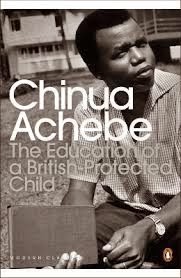
I recently read Chinua Achebe’s memoir; “the Education of a British Protected Child”. The book resonated with me especially because of its focus on identity, culture, family, Nigerian and African politics and the relevance of the events he depicted to current events. Of course the author brings his own narrative and views; yet this does not colour the essence of what he says.
In “What is Nigeria to me”, he breaks down his identity as a Nigerian and the optimism that greeted Nigeria’s independence. He recalled; “travelling as a Nigerian was exciting, people listened to us. Our money was worth more than the dollar". Though he experienced racism in North Rhodesia (Zambia). His retort to the ticket collector that “by the way, in Nigeria we sit where we like in the bus” was an aha moment in understanding race relations at that time. His conclusion-“being a Nigerian is abysmally frustrating and unbelievably exciting"- captures the frustration and feeling I experience as a Nigerian.
In the following chapter, “Travelling White", he examines racism in Africa. The subjugation Africans suffered on their land may explain the resentment towards White Africans. But do two wrongs make a right?
In the final story Achebe continues on the theme of white racism, how the narrative has been controlled and how black people view themselves with the lenses of former oppressors. He noted the almost equal relationship that existed pre-slavery (Walter Guyana also documented how developed Africa was before slavery in “How Europe Underdeveloped Africa”). My take is that as Africans, we have to develop ourselves and shape our own stories. Like the Yoruba proverb goes “if the in-house murderer does not kill one, the one outside would not succeed. Who are we? What do we want for ourselves? Obviously, we have lost years to slavery, colonialism and neo-colonialism. Our destiny is in our hands. Are we taking it?
Though the book has repetitive stories, I recommend the book as a good read and as a teaser, enjoy these three chapters
|
Saturday, February 28, 2015
Saturday, February 21, 2015
On the postponement
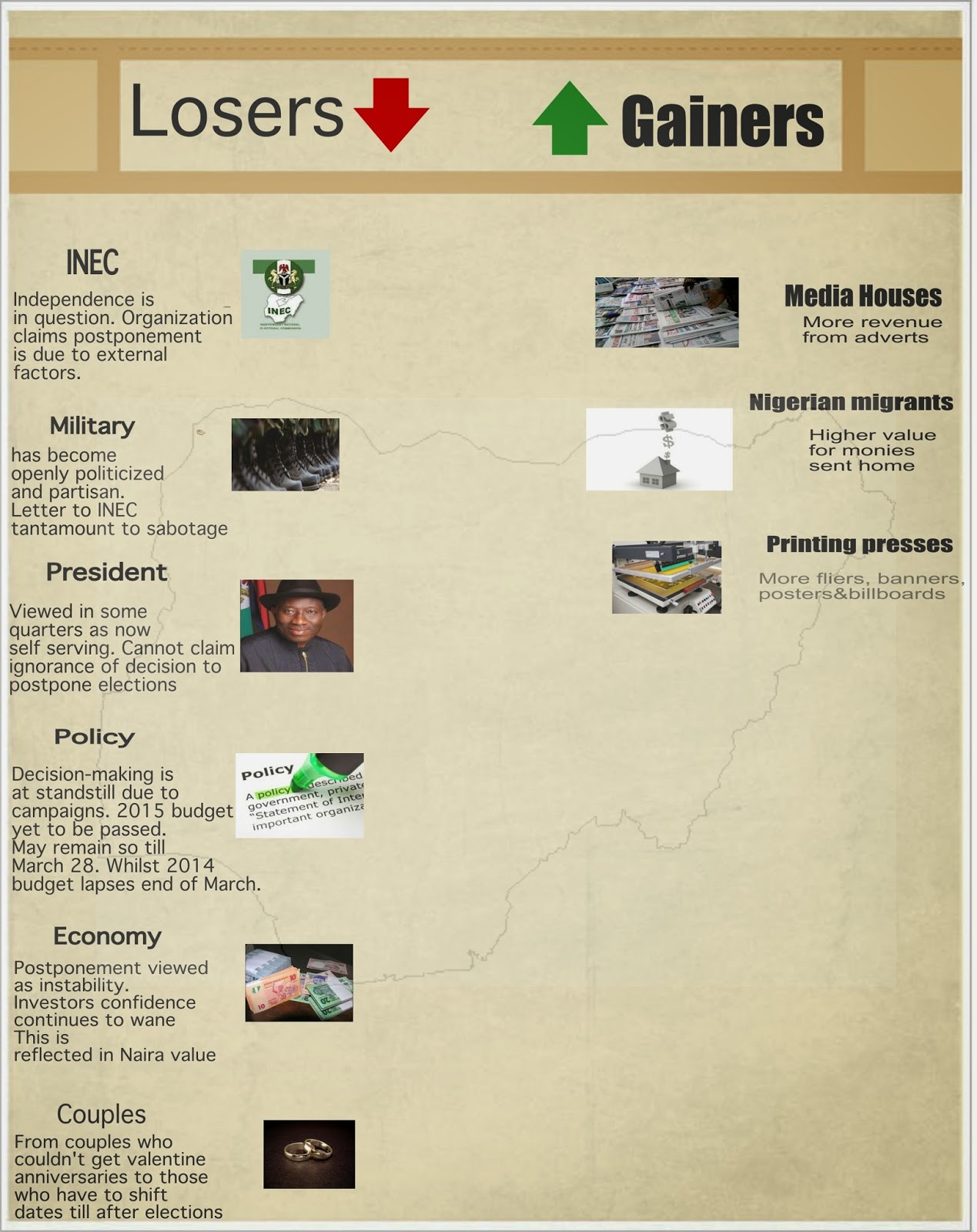
Had the presidential elections held on the 14 of February, Nigerians would have known the captain of her ship till 2019. To be clear, it is within INEC's right to postpone elections within set time frames (Part IV, Section 26). However, this postponement rankles because the Commission categorically stated that it was ready to go ahead with the elections but the nation's security forces openly stated that they will not provide support for elections on the 14th after the National Security Adviser (NSA) had called for a postponement. Who benefits and who loses? At face value, PDP and it supporters through various campaigns benefit as they gain more time to contain the momentum APC had on its side. But did they really benefit? Since the postponement, Boko Haram- that the Military wants to contain in 6 weeks- has attacked several villages, the Naira has further lost its value and investors are bidding their time till after the elections hold. Who loses and who gains?
 |
| Photo credits: www.adler.edu,www.keele.ac.uk, www.punchng.com,www.bbc.co.uk,www.wscij.org,ww,w.goodreturns.in, |
Friday, February 13, 2015
Overtake don Overtake Overtake
Title credit goes to Fela
The current events in Nigeria- the falling naira (officially now at NGN 205 to $1), the effects of the oil glut and falling oil prices (Brent oil which Nigeria produces sells for $56pbd), yet the benchmark for our budget is $65 per barrel and the leakages in the system that are not fixed portend what the times Nigerians are in for.
I get my money
Plan my plan finish
Start to go for market
Start to go for shopping
Before I reach market nko o?
Government show don enter
My plan don spoil o
Government show don enter
My plan don spoil o
Plan my plan finish
Start to go for market
Start to go for shopping
Before I reach market nko o?
Government show don enter
My plan don spoil o
Government show don enter
My plan don spoil o
My friend wan come buy
fan
Him dey sweat for him dey sleep for room
Him dey for level of three
The fan na seventy-five naira
My friend him dey follow salary
Him dey try to save and save and save
Every time he nearly buy the fan
Government go add ten naira more
Every time he nearly buy the fan
Government go start one activity
Till the fan reach two hundred naira
My friend nearly die, he never die
My friend he no wan die
Die-die no dey for him dictionary
For where? Huh...
Him dey try to save and save again
Him save for one year and six months
Inside cupboard
Under pillow
Under, under cooking pot
Inside socks
Under carpet
Him dey on his way to buy the fan
When alarm come blow
Him dey sweat for him dey sleep for room
Him dey for level of three
The fan na seventy-five naira
My friend him dey follow salary
Him dey try to save and save and save
Every time he nearly buy the fan
Government go add ten naira more
Every time he nearly buy the fan
Government go start one activity
Till the fan reach two hundred naira
My friend nearly die, he never die
My friend he no wan die
Die-die no dey for him dictionary
For where? Huh...
Him dey try to save and save again
Him save for one year and six months
Inside cupboard
Under pillow
Under, under cooking pot
Inside socks
Under carpet
Him dey on his way to buy the fan
When alarm come blow
Government announce
second tier
Everything come tear to pieces
Everything come expensive
Even water become expensive
Fan don become seven hundred naira
Me and my friend start to look ourselves
He remain small make my friend dey cry
Na laugh laugh he catch monkey
Na now he come understand him life
Enjoyment can never come him way
Na now him life dey go reverse
In Africa, him fatherland
Everything come tear to pieces
Everything come expensive
Even water become expensive
Fan don become seven hundred naira
Me and my friend start to look ourselves
He remain small make my friend dey cry
Na laugh laugh he catch monkey
Na now he come understand him life
Enjoyment can never come him way
Na now him life dey go reverse
In Africa, him fatherland
credit: Lyrics of Fela's O.D.O.O
The current events in Nigeria- the falling naira (officially now at NGN 205 to $1), the effects of the oil glut and falling oil prices (Brent oil which Nigeria produces sells for $56pbd), yet the benchmark for our budget is $65 per barrel and the leakages in the system that are not fixed portend what the times Nigerians are in for.
We have a budget of
4.3 trillion naira and the government may have to borrow to fund it yet agencies like NNPC and FIRS answer to themselves and remit to the Federal Government
what they please. FIRS generated 4.69 trillion
in 2014
Citizens may not immediately see the impact of our dwindling fortunes because oil
revenues primarily go to the government with little effects on the average
Nigerian because governments at all levels fail to carry out their duties. The government wants to begin austerity measures most Nigerians have been for ages. Unfortunately, citizens have to now embark on austerity 2.0.
The
combination of lower oil prices (which means that oil proceeds to the
government is reduced), the devaluation of the Naira(because Central Bank
can no longer afford to defend the Naira). Sadly, the failure to hold governments responsible has come back
to bite us and those who may be unaffected are very wealthy Nigerians
We are a consumer economy that imports a significant number of items
including food, clothing and machines to run factories. Imports are denominated in dollars and importers will require
more naira to get dollars to import the same amount of goods. They definitely will pass the
costs to consumers. Imagine a trader buys 1000 units of a good at $1 per unit,
In December, the cost was between NGN 165-170,now, that same good will cost NGN
210 to import. Received information is that the exchange rate will rise to NGN 250 and the Naira maybe devalued again. The increases in cost of goods means a reduction in purchasing power. For instance, NGN100 bread may now go for NGN 150
Second, there is
going to be a differentiation between the wealthy and the rich. For the
nouveaux, wanna- be rich, family vacations may no longer be affordable. With
current exchange rate, a flight to London will cost $663 for
the fare and $590 for the tax and charges which goes to the government of
Nigeria. The ticket per person will cost N244, 0000 and this is not even
summer! At that time last year, this would have paid for 12 hours trip to
the United States. Thus,a father of 3 may have to shell out 1.2 million ($6000)
for tickets alone.
Parents will see an increase in schools and goodluck to those who pay fees in dollars and pounds either in Nigeria or abroad.Add to that the retinue of
dependants people are responsible for. Indeed, the days of "Uncle please I
need 10,000 for project", "please send me recharge card" may be
over because people's disposable income will be reduced.
The poor and working-poor
Nigerians would also be impacted as food prices will increase. This government
has touted its achievement in reducing our food import bill to $4.3 billion. Unfortunately, we still import
foodstuff and items like kerosene stoves and cutlery.
Finally, the value of
whatever savings people may have (except it is saved in foreign exchange) has been
effectively reduced. People saving to buy a car, a dress- anything that will be
imported will have to save more. History did not have to repeat itself and it would not have if only we learned from the past and put our leaders on their toes.
Saturday, January 31, 2015
The Last Days of Pompeii
Nigeria is still a deeply rural country. I recently travelled South West Nigeria and came across kilometers upon kilometers of green land. For a supposedly developed South West, one can only imagine the scenery in the North. As I travelled, I saw unmaintained, dilapidated and decrepit government institutions- post offices, hospitals,schools, narrow, very narrow but tarred roads. It was picture been caught in a period. Stagnancy with no plans for the future.
For people who live in these areas, issues like development, the future, growth and "well-being, takes on a new meaning. That some 219 girls are missing does not ring a bell or connote any significance to them. What is important is getting by- putting food on the table, how the children will have some form of education and leave for the city, making sure phone lines work and they are not shafted my phone networks and resolve mundane family issues and slights. It's a little wonder stomach infrastructure is thriving. People are consumed by the present that cannot envision beyond today.
This raises the question of how a government can efficiently work on providing infrastructure, sound educational system and standard health care facilities whilst maintaining the pastoral and agrarian nature of the people, leaving them in their countrified agrarian bliss. Will creating that balance in any way reduce rural-urban migration and stem the the overcrowding of cities? Nigeria's estimated population in 15 years is 250 million and by 2050 she will be the 4th most populous country in the world with an estimated population of 440 million. With the current state of infrastructure and institutions especially in education and health, are we ready for the future?
16-20 years ago, as I prepared for high school, we used to sing "education for all by the year 2000"- that was the mantra. Year 2000 was the magical year where everything would fall into place- education for all, health for all...
15 years from year 2000, I did not imagine that rather than improve, the state of education, health and infrastructure would degenerate.How do we get those who should care about setting innovative and futuristic policies to do so? What are we going to do about the North that lagged behind in education before the security crisis - especially in the area of type of education and access to education? Is a situation where a graduate cannot add two and two or understand basic logic acceptable for Nigeria?
An estimated 10.5 million kids are out of primary school (2010 figures) can that continue? Can we afford to let those who rule us (at legislative and executive levels) get away with the waste and current grab-all-you-can attitude with developing the country? Can we afford our rulers to continue to loot our commonwealth?
Food for thought.
Monday, January 26, 2015
On Buharis Certificate……..

Source: http://bit.ly/1ykSEVd
I follow the campaigns of President Goodluck Jonathan and Gen Muhamadu Buhari and they have been interesting. Parties and their spokesmen have thrown caution to the winds in their bid to promote their candidate as the best thing Nigeria deserves. They have done this without regards for the potential effects their hate speech and adverts may have. Rather than engage in issue- based campaigns, they have embarked on mudslinging and smear campaigns. This has shown that the major actors- PDP and APC are scared and desperate!
I do not support or believe
in any of the candidates. It is highly disappointing that President
Jonathan’s incompetence and non-performance has made Gen Buhari “the
best”. I still wonder how APC delegates and the Party itself can claim
they cannot provide a better candidate.
Sadly, the campaigns of
both candidates have ignored salient issues that affect ordinary Nigerians.
President Jonathan’s "best achievements" are agriculture and provision of trains! He has no manifesto for the next four years, whilst APC is campaigning on the promise of cash transfers, providing security
and revamping the economy without stating how it will be done. Issues that border on the
falling economy, the dropping oil prices, declining reserves, reliance on
petrodollars, infrastructure development and the first duty of government which
is the protection of lives and property is not being addressed. Rather the campaigns
especially that of PDP, has focused on mundane issues, bashing and tarnishing
the image of the other party.
One of such is the allegation against Buhari
on his eligibility to contest “as he seem not to have gone through primary and
secondary school”. This allegation is interesting and amusing because
whoever conceived this allegation as a smear campaign did not think of the
ripple effect – if we were a country that asked questions and followed
through- on Nigeria system as a whole. This begs questions like: what
has this government been doing? The rot and impunity (the impunity
that is so rife that the government tolerates any and everything).Nigeria is
suffering its own version of the broken window theory. The rot that has eaten
into the system is so deep that I don’t see a way any human being can
clean this up in the nearest future.
I digress. Back to Buharis certificate my
thoughts are as follows:
Buhari is contesting for the
office of the president of Nigeria for the 4th time (2nd time
against President Jonathan) how come the issue of eligibility is just
coming up?
If the allegation is true, are
the sponsors of this campaign telling us that INEC is not credible enough
to do its job of verifying candidate eligibility and conducting elections? This
calls into the question the eligibility of all those who are contesting
and have contested and won elections from the Councilors and Local
government chairmen to the National Assembly and Presidency as we are unsure
INEC followed due process. Would we be able to trust the
outcome of this election? Isn't this an indication of gross incompetency
and failure in keeping proper records?
If the allegation is true, is the
Nigerian government telling us that the Nigerian Army has also failed due
process in Army recruitment and verification of records?
An army spokesman today in a press
conference said:
“Records available indicate that
Major General M Buhari applied to join the military as a Form Six student of
the Provincial Secondary School, Katsina on 18 Oct 61. His application was duly
endorsed by the Principal of the school, who also wrote a report on him and
recommended him to be suitable for military commission. It is a practice in the
NA that before candidates are shortlisted for commissioning into the officers’
cadre of the Service, the Selection Board verifies the original copies of
credentials that are presented.
However, there is no available record to show that this process was followed in the 1960s.
Nevertheless, the entry made on the NA Form 199A at the point of documentation after commission as an officer indicated that the former Head of State obtained the West African School Certificate (WASC) in 1961 with credits in relevant subjects: English Language, Geography, History, Health Science, Hausa and a pass in English Literature. Neither the original copy, Certified True Copy (CTC) nor statement of result of Major General M Buhari's WASC result is in his personal file” (read here).
However, there is no available record to show that this process was followed in the 1960s.
Nevertheless, the entry made on the NA Form 199A at the point of documentation after commission as an officer indicated that the former Head of State obtained the West African School Certificate (WASC) in 1961 with credits in relevant subjects: English Language, Geography, History, Health Science, Hausa and a pass in English Literature. Neither the original copy, Certified True Copy (CTC) nor statement of result of Major General M Buhari's WASC result is in his personal file” (read here).
How can one explain that a
man can rise up to the prestigious level of a Major General and at no point was
any verification done on his records and eligibility to hold the
position he did?
In another vein, Chapter 6,
Section 131 of the 1999 constitution states:
131. A person shall be qualified for election to
the office of the President if -
(a) he is a citizen of Nigeria by birth;
(b) he has attained the age of forty years;
(c) he is a member of a political party and is sponsored by that
political party; and
(d) he has been educated up to at least School Certificate level or its
equivalent.
The Constitution in section 318 clarifies what school certificate means
as:
"School Certificate or its
equivalent" means
(a) a Secondary School Certificate or its equivalent, or Grade II
Teacher’s Certificate, the City and Guilds Certificate; or
(b) education up to Secondary School Certificate level; or
(c) Primary Six School Leaving Certificate or its equivalent and -
(i) service in the public or private sector in the Federation in
any capacity acceptable to the Independent National Electoral Commission for a
minimum of ten years, and
(ii) attendance at courses and training in such institutions as may
be acceptable to the Independent National Electoral Commission for periods
totaling up to a minimum of one year, and

(iii) the ability to read, write, understand and communicate in the
English language to the satisfaction of the Independent National Electoral
Commission, and
(d) any other qualification acceptable by the Independent National
Electoral Commission;
I conclude that public
institutions are being politicized (que- Department of State Security and
Nigerian Army) and this is a dangerous trend. I suspect
there is a certificate eating rat in the Army’s records
office.Where do we go from here? Who will tow the path of clean campaigns?
Monday, January 19, 2015
Their Strength is their gun
I had 3 experiences with the police officers. These experiences have made me ponder on the safety of citizens. The leadership of the police force is now involved in partisan politics rather than equip its officers to perform their duties of enforcing law and order.
Scene 1
I
was stopped by a police officer who requested I tip her to celebrate the
holidays. She was not at the checkpoint to prevent crime or ensure
law and order. She was there as a beggar in uniform. I smiled and
told her I did not have anything and she said :"You know I am in
uniform", I can collect your bag. It would look good on me" (read as: "better comply or this conversation will take another turn"). I smiled again
and told her not today, next time.
Scene 2
Police
officers in an unmarked car accosted a friend and I. We parked and they came
out with their guns ready for action. One of the officers requested for the
papers of the car. Friend,who was compliant and polite, handed over the car
documents and the officer checked it. They asked some questions and friend
answered their questions convincingly and confidently. Friend's manner and way
with words left Police officers stuttering and explaining why
we were stopped and how we should not be offended. I left the scene thinking if
we had stolen the car, we would have gotten away. Police officers need to move
from "happy weekend sir" and "anything for us" to being able to
hold a conversation with citizens without being forceful, threatening and
unreasonable or timid and docile. As we drove off, I also thought considering
the way the officers that stopped us were dressed and their carriage, they
could be police officers by day and robbers by night
Scene 3
I
met a group of local policemen in a State and hope arose that community
policing might work in Nigeria because the officers will be familiar with
the people and terrain, thus making prevention and solving crimes easier.
However, my hope was short lived. On interaction with some of them, all they
discussed was how get by. If someone had come to report a crime, they
would not know what to do. They probably address issues with their native
reasoning.
The police force is the first level of security people have. 312, 669, 237 ( recurrent expenditure covering personnel and overheads)- 229 billion for salaries and 489 million for training has been allocated to police formations in the 2015 budget and 17,000,000,000 for capital projects. Hopefully, these monies if appropriated will be used for the stated purposes especially in the area of training.
Cheers
Friday, January 16, 2015
STILL ON INEC
I have written on my experience trying to register during the Continuous Voters Registration for the February elections. The experience was horrendous and If I did not have an understanding manager, I definitely would not have been able to register. I spent three days trying to register and was successful because of my persistence and the officials who had been seeing me around. The process the electoral body used to register during the last exercise automatically disenfranchised citizens who want to vote and also have to go to work.
Government processes and procedures do not have to be tedious and miserable. Man hours do not have to be wasted because citizens want to perform their civic duties. An easy and efficient process is possible
I saw this first hand when I processed my Driver’s license. I decided not to pay anyone to process my driver’s license so in April/May 2014, I filled the online form on the government’s portal and paid the fees. The forms were submitted to the FRSC and I waited to be called for capture- the stage where my biometric data capture will be taken. I received a text about a month later to come for capture but I did not go on my appointment date. I went to the centre on a random day in July with my father hoping that his grey hair will work wonders and I am not turned back.
Fortunately, I did not have to. We explained to the official that I missed my appointment and all he asked for was the appointment date and he retrieved my records. He told me to join the queue. In 45 minutes, without tipping or knowing anyone, I was done and I was given my temporary driver’s license. I was so amazed at the efficiency and service of the officials. Another colleague had a similar experience processing her Driver's License. I am aware other people have different stories to tell but my experience shows that the grief and agony that citizens experience with public institutions is man-made and unnecessary.
Institutions through lack of administrative organization create unpleasantness so that people are incentivized to pay for faster service which is not remitted to the government - though there are some people who are impatient and want to beat the system-
Back to registration nightmare, humans were treated like goats. We stood hours on end in the sun waiting to register, area boys came with sticks and bottles to disrupt the queues so that people who have paid them would register. Even for the staff, registration was tormenting. The idea of making them sit in the sun, giving them laptops with no means to charge them when the system powers down is undignifying. At the polling unit I registered, some residents provided the generator and fuel that was used to charge the systems. Some provided food. The officials will arrive at about 10am and prepare to leave by 4-4.30.
INEC was/is not well prepared for the elections. First, voters registration should be continuous and should have started since 2012 or 2013 especially since the cards are not produced locally. Giving a one-week timeline to register people is constraining. Registration of voters and preparing a Voters register should not be exclusive.
Alternatively, INEC and FRSC should collaborate so that when people come to get their driver’s license they are automatically registered. Then, fresh voters can register and vote in any location. At the FRSC location, citizens can indicate their LG and INEC will derive their polling units for logistics purposes and also inform citizens their polling units.
However,if INEC wants to keep its own records because not everyone will get a license, citizens should be able to walk into the INEC office in the Local government and be able to register and be issued temporary voters cards ala my FRSC experience at any time. The merit of this method is that there would be no rush and pressure on citizens and the officials.
The electoral body has stated that PVCs will be used to vote in the 2015 elections and this decision may disenfranchise three groups of people.
- People who registered but their records were not captured when they checked their status with INEC whilst the organization has discontinued CVR
- People like me who just registered and INEC is unlikely to produce our PVCs. In a speech on the 14th of January, the INEC Chairman reiterated the need to use PVCs because the card reader will prevent rigging though the House of Representatives has approved the use of Temporary Voters Cards
- People who moved states and are unable to go to their previous states to pick up their PVCs and have to write to INEC and wait 30 days for a response.
The commendable and almost flawless conduct of elections and distribution of cards is Ekiti, Osun, Anambra and Edo where staggered elections held shows that the organization knows what to do. For an important election such as the one holding this February, the organization cannot afford any administrative lapses that will skew or mar the elections. They can start by simplifying processes.
FYI:
- INEC website
- PVR distribution as at 7th January by State
- Total number of registered voters- 68,833,476
- Total number of PVCs collected- 38,774,391
Wednesday, December 31, 2014
2014 in review
2014 was the year:
The continent saw Ebola coming yet failed to take action till it ravaged and ravages West Africa
Over 276 girls were kidnapped and 219 of them who were unable to escape remain in captivity. Our government has moved on.
The chickens came home to roost for Nigeria's crude oil and its price. Unfortunately, the government will not give up its lifestyle. Nigerian consumers have to pay
We discovered selfless Nigerians ala Dr Adadevoh
Stomach infrastructure was redefined
CBN stopped defending the Naira and it got devalued
Nigerian students in the US were recognized as exceptional
Nigerian Football Federation refused to put its house in order
Impunity reigned
2014.....
The continent saw Ebola coming yet failed to take action till it ravaged and ravages West Africa
Over 276 girls were kidnapped and 219 of them who were unable to escape remain in captivity. Our government has moved on.
The chickens came home to roost for Nigeria's crude oil and its price. Unfortunately, the government will not give up its lifestyle. Nigerian consumers have to pay
We discovered selfless Nigerians ala Dr Adadevoh
Stomach infrastructure was redefined
CBN stopped defending the Naira and it got devalued
Nigerian students in the US were recognized as exceptional
Nigerian Football Federation refused to put its house in order
Impunity reigned
2014.....
Saturday, December 13, 2014
Goodluck 2015?
As expected, President Goodluck Jonathan bowed to the wishes of the
people to run as president in the 2015 elections despite his public claim that
he would not run in 2015.
That the president is standing as a candidate for next year's election
is not an issue. He has the right to. The concern is the volte face and lack of
principle that has become a characteristic of Nigerian politics. From governors
and legislators
who switch political parties for personal interests to Mr President who
declared in 2011 that "I would
have loved that the Nigerians in Diaspora vote this year but to be frank with
you, that is going to be difficult now. Presently, the law does not allow the
voting outside Nigeria and so this year Nigerians in Diaspora will not vote but
I will work towards it by 2015 even though I will not be running for
election.",changing their minds is a constant. A constant that is a
disservice to the people they claim to represent.
In 2010, when the sitting president first declared his intention to
run he stated all the policies he would put in place to take Nigeria to Canaan.
Not so long after he was elected, the fuel queues and petroleum issues he
promised to address returned and thanks to him, fuel prices increased by 100% before
protests brought it down to NGN 97. The corruption he vowed to tackle is no
longer Nigeria's major problem
because what Nigerians regard as corruption is mere
stealing. In 2010 he promised to fight crime and now in 2015 he is
promising to punish suicide bombers. Mr President sold Nigerians hope but
hope is not enough. That he progressed from someone without shoes to a President
is not and will not be the reality for many people in similar circumstances that
he was in because the ineptitude of his government means that those in his
shoes may never get out of their situation save for a miracle. Yes,
Jonathan is neither the cause of the problems in Nigeria nor the problem
with Nigeria. However, he has contributed in no small means to deepening
the problems and challenges Nigerians face in their quest for a
decent life. Nigeria’s problems have from just a tear to big hole that gets
harder to mend.
By failing to perform the basic duty of government, which is to ensure
the security and welfare of citizens irrespective of where they are from, his
government cops out of its responsibilities by blaming the opposition and
tarring every criticism as the work of those who do not mean Mr Jonathan well.
The President need not campaign if the attacks in
Northern Nigeria was decisively tackled and an example was of the so-called
opposition that sponsor the violence. The return of the Chibok girls will
be a great start. Prosecuting those who pillage the nation's common wealth will
be a great follow-up- starting with those who benefit from the oil-subsidy scam
to government officials in military and public institutions. Delivering on the
promise of constant electricity- which is 31/2 years overdue will
further spur the growth of our economy- where citizens survive inspite of the
enormous hurdles they face and revitalizing our healthcare systems (both the
people and infrastructure).
These achievements will speak for him and "fans" of the
president will not spend the huge amounts currently being spent to sell his
"successes".
In his declaration speech for 2015, the president, unlike in 2010, makes
vague promises. His declaration is empty and showed no direction for the future .
In 2010, he said, "if I’m
voted into power within the next four years, the issue of power will become a
thing of the past. Four years is enough for anyone in power to make significant
improvement and if I can’t improve on power within this period, it then means I
cannot do anything even if I am there for the next four years.”
Does this president deserve to repeat his term?